

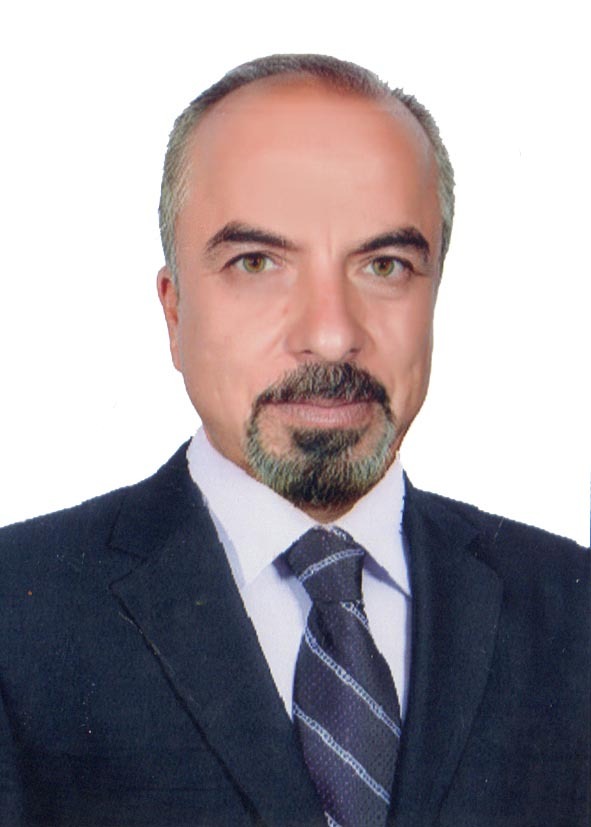
marwan khaleel majeed
Research InterestsArtificial Intelligence
Pattern Recognition
Medical Image Analysis using Deep Neural Networks.
| Gender | MALE |
|---|---|
| Place of Work | Mosul Medical Technical Institute |
| Department | Anesthesia Techniques |
| Position | Government Contracts Unit Officer // Quality Assurance Unit Officer |
| Qualification | Master |
| Speciality | Computer Science - Pattern recognition |
| marwankh1970@ntu.edu.iq | |
| Phone | 07740870466 |
| Address | Al-minassa street, Mosul, Ninevah, Iraq |



Academic Qualifications
Master's in Computer Science – Specialization: Artificial Intelligence / Pattern Recognition
University of Zarqa, Jordan
Graduation Year: 2021
Thesis Title: "Application of Deep Learning Techniques in Pattern Recognition within Medical Images"
Bachelor’s Degree in Computer Science
University of Mosul, Iraq
Graduation Year: 2009
Bachelor’s Degree in Law
University of Mosul, Iraq
Graduation Year: 2022
Diploma in Chemical Industries
University of Mosul, Iraq
Graduation Year: 2004-2005
Professional Experience
Assistant lecturer of Computer Science
Northern Technical University - Mosul Technical Medical Institute
• Teaching courses in computer science, with a special focus on artificial intelligence and machine learning.
• Supervising student graduation projects in the fields of artificial intelligence and data analysis.
• Developing academic projects using pattern recognition techniques in data and images.
o Design and train deep learning models for medical image analysis and pattern recognition.
o Applying machine learning techniques to improve the accuracy of models in classification and prediction.
o Analyzing model results and improving performance using hyperparameter tuning techniques.
Technical Skills
• Programming Languages: Python, R, Java
• Machine Learning Libraries: TensorFlow, PyTorch, Keras
• Pattern Recognition Techniques: CNN, SVM, Decision Trees, Clustering
• Data Analysis Tools: NumPy, Pandas, Matplotlib, Seaborn
• Operating Systems: Linux, Windows
________________________________________
Certifications and Courses
• Coursera Certificate in Deep Learning Specialization
• Courses GBV.
• Courses First Aid.
• Cisco courses IT.
• Firefighting courses.
• A course in TOT.
Languages
• Arabic: Native
• English: Excellent (Reading, Writing, Speaking)
Hobbies and Interests
• Participating in open-source projects related to Artificial Intelligence
• Analyzing images and videos using pattern recognition techniques
• Keeping up-to-date with research advancements in Artificial Intelligence and Deep Learning
Publications
Compression-based stegoanalysis of audio signals: Algorithm design and experimental validation
Feb 17, 2026Journal International Journal of Research in Advanced Engineering and Technology
Issue 2
Volume 11
Abstract In recent years, the integration of digital signal processing with information security technologies has intensified interest in steganography and its counterpart, stegoanalysis. Owing to their continuous and widely distributed nature, audio signals represent an excellent medium for both information hiding and detection research. This study presents a robust compressionbased stegoanalysis method designed to automatically detect hidden data within WAVE audio files through statistical variations in the least significant bits (LSBs). The proposed algorithm operates by comparing the compression ratios of original and potentially modified audio files, allowing the detection of concealed information with high accuracy and efficiency. Experimental validation across various datasets—comprising speech, classical, and dynamic music—demonstrates that the WinZIP® 14.5 compression approach outperforms WinRAR® 5.50 in sensitivity and precision. The results confirm that the proposed model is computationally efficient, scalable, and highly applicable for automated steganographic detection in digital audio systems. Abstract In recent years, the integration of digital signal processing with information security technologies has intensified interest in steganography and its counterpart, stegoanalysis. Owing to their continuous and widely distributed nature, audio signals represent an excellent medium for both information hiding and detection research. This study presents a robust compressionbased stegoanalysis method designed to automatically detect hidden data within WAVE audio files through statistical variations in the least significant bits (LSBs). The proposed algorithm operates by comparing the compression ratios of original and potentially modified audio files, allowing the detection of concealed information with high accuracy and efficiency. Experimental validation across various datasets—comprising speech, classical, and dynamic music—demonstrates that the WinZIP® 14.5 compression approach outperforms WinRAR® 5.50 in sensitivity and precision. The results confirm that the proposed model is computationally efficient, scalable, and highly applicable for automated steganographic detection in digital audio systems.
Individual Recognition Based on Multi-Spectrum Palm Images
Feb 17, 2026Journal The Scholar Journal for Science & Technology
Issue 5
Volume 2
Abstract: Individual recognition based on palm images is such an interesting subject. In this paper, multi-spectrums for full-palm images are considered. The spectra of 460nm and 940nm are employed. Each spectrum provides special features. That is, the spectrum of 460nm affords full-palm textures, and the spectrum of 940nm presents full-palm veins. These facilities are utilized here, where an Artificial Intelligence (AI) approach is suggested. The suggested approach consists of four Deep Learning (DL) networks. Each network is determined for a certain full-palm image, as there are four types of images: right hand full-palm textures, left hand full-palm textures, right-hand full-palm veins, and left-hand fullpalm veins. Then, the outputs are fused to provide the final recognition decision. Two datasets are exploited; both are from the Chinese Academy of Sciences Institute of Automation's (CASIA) Multi-Spectral Palmprint Image Database (version. 1.0), where full-palm images of the two spectra 460nm and 940nm are obtained. High performances are achieved after applying the suggested approach. Individual recognition based on palm images is such an interesting subject. In this paper, multi-spectrums for full-palm images are considered. The spectra of 460nm and 940nm are employed. Each spectrum provides special features. That is, the spectrum of 460nm affords full-palm textures, and the spectrum of 940nm presents full-palm veins. These facilities are utilized here, where an Artificial Intelligence (AI) approach is suggested. The suggested approach consists of four Deep Learning (DL) networks. Each network is determined for a certain full-palm image, as there are four types of images: right hand full-palm textures, left hand full-palm textures, right-hand full-palm veins, and left-hand fullpalm veins. Then, the outputs are fused to provide the final recognition decision. Two datasets are exploited; both are from the Chinese Academy of Sciences Institute of Automation's (CASIA) Multi-Spectral Palmprint Image Database (version. 1.0), where full-palm images of the two spectra 460nm and 940nm are obtained. High performances are achieved after applying the suggested approach.