
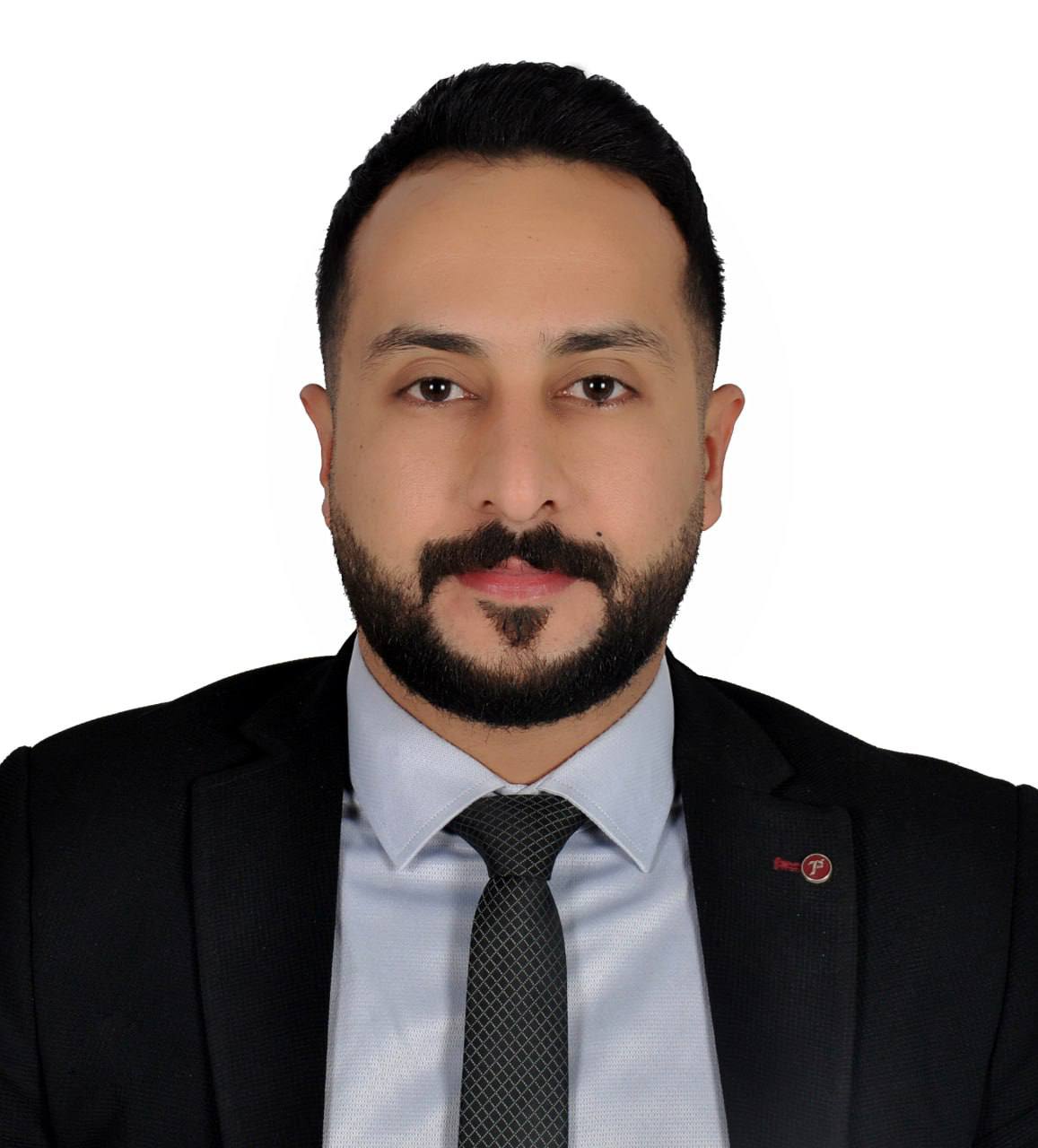
Mustafa Mahmood Meteab
Research InterestsHR. Strategic Management. Marketing
AI
| Gender | MALE |
|---|---|
| Place of Work | Technical Engineering College for Computer and AI / Kirkuk |
| Department | Artificial Intelligence Technology Engineering |
| Position | Head of the Arabic Language Integrity Unit |
| Qualification | Master |
| Speciality | Business Administration/HR |
| Mustafamba0@ntu.edu.iq | |
| Phone | 07702350087 |
| Address | Kirkuk - Domiz - Rashid neighborhood, Kirkuk, Kirkuk, Iraq |




Follow Me
Skills
Basic Computing Proficiency (100%)
Microsoft Office Suite Mastery (90%)
Data Analysis & Decision Making (70%)
Strategic Planning & Project (85%)
Leadership & Team Building (80%)
Academic Qualification
Master of Business Administration - MBA
Oct 4, 2015 - Jan 31, 2018Human Resources - HR
Working Experience
مقرر قسم [مقرر قسم تقنيات المحاسبة]
Nov 13, 2019 - Feb 15, 2019مهام مقررسة القسم في الدراسة المسائية وما يتعلق بها من الشؤون الطلابية والعلمية ومهام اللجنة الامحتانية
شعبة الدراسات والتخطيط [مسؤول شعبة الدراسات والتخطيط]
Aug 29, 2023 - Sep 24, 2024الادارة والاتصال الفعال مع مسؤولي وحدات شعبة الدراسات والتخطيط، كل من وحدة الشؤون العلمية، وحدة الاحصاء، وحدة الحاضنة التكنولوجية، وحدة البيانات EMS، وحدة التدريب الصيفي وحدة التعليم المستمر، حلقة وصل ومتابعة بين مسؤولي الوحدات والمعاون العلمي، اضافة الى مهام عضوية الارتباط مع الجامعة كالبحوث التطبيقية ومنصة المستودع الرقمي والبعثات والعلاقات الثقافية، ومنظومة EMS
Publications
The Effects of Iraq Borrowing from International Financial Institutions
Aug 21, 2025Journal American Journal of Business Practice
publisher Semantic Journals Publishing
Issue NO. 8
Volume Vol.2 No. 8
This research examines the effects of Iraq’s borrowing from international financial institutions, such as the International Monetary Fund and the World Bank, on the structure and performance of the Iraqi economy. It highlights how Iraq’s heavy dependence on oil as the primary source of revenue has made the country vulnerable to oil price fluctuations, prompting frequent recourse to external borrowing to cover budget deficits, finance operational and military expenditures, and fund reconstruction projects. The study traces the evolution of Iraq’s public debt from the monarchy period to the post-2003 era and analyzes its impact on savings, investment, economic development, monetary and fiscal policies, the private sector, and inflation. It also discusses the obstacles hindering the use of loans for productive projects, including administrative and financial corruption, security instability, and weak strategic planning. The research concludes that mismanagement of loans increases debt burdens without achieving sustainable development and stresses the need to direct borrowing toward productive projects that diversify the economy and reduce dependence on oil, alongside implementing structural reforms in financial and economic governance.
Democratic leadership practices and their impact on achieving strategic sovereignty: An exploratory study of the opinions of a sample of administrative leaders at the University of Kirkuk
Aug 30, 2023Journal Tikrit Journal of Administrative and Economic Sciences
publisher Semantic Journals Publishing
DOI 10.25130/tjaes.19.SP3.2.29
Issue Special Issue, Part (2)
Volume Vol. 19
The research aimed to understand the impact of democratic leadership on achieving strategic sovereignty at the University of Kirkuk. A problem centered on what are the practices of democratic leadership followed by the leaders of the researched university and how they affect the achievement of strategic sovereignty. The University of Kirkuk was chosen as a field for study through a sample of (102) academic leaders from the origin of the total study population of (107) academic leaders, as it was (93) questionnaire valid for statistical analysis, and the researchers used the descriptive analytical approach in order to reach the results, and the study adopted a set of tests using the statistical analysis program (SPSSV.23) to test the research objectives and hypotheses. The research came out with a set of results that were in conformity with its hypotheses, the most important of which was the existence of a significant correlation and influence between the practices of democratic leadership and strategic sovereignty at the University of Kirkuk.