

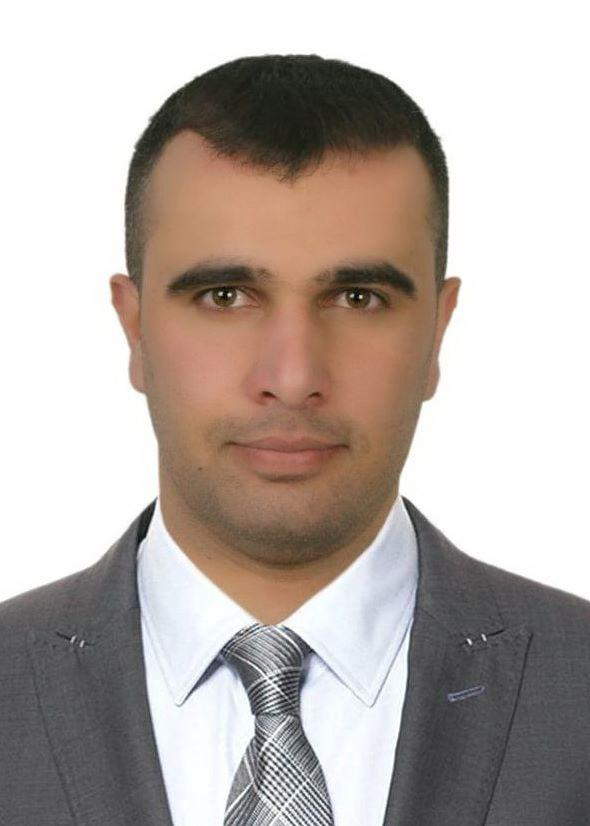
Ayad Dawood Sulaiman Mahmood
Research InterestsHeat transfer
Fluid flow
Renewable Energy
HVAC Systems
Heat Pipes Technologies
| Gender | MALE |
|---|---|
| Place of Work | Polytechnic College Mosul |
| Department | Department of Autotronics Engineering Techniques |
| Position | Department Coordinator |
| Qualification | Master |
| Speciality | Thermal Engineering Technology |
| ayad.dawood@ntu.edu.iq | |
| Phone | +9647729683972 |
| Address | Hay Al-Arabi, Nineveh Governorate, Mosul, Iraq |






1 +
Publication in Thermal Science and Engineering Progress (Impact Factor: 5.4, CiteScore: 7.3).
Skills
AutoCad (90%)
Experimental techniques in refrigeration & HVAC systems (80%)
ANSYS (70%)
SolidWorks (70%)
Working Experience
Coordinator [Coordinator]
Feb 8, 2024 - Present1- Coordinator of the Power Mechanics Techniques Department, Northern Technical University (2024 – 2024)
2- Coordinator of Air conditioning and Refrigeration Techniques Department, Northern Technical University (2024 – 2025)
3- Coordinator of Department of Autotronics Engineering Techniques, Northern Technical University (2025 – Present)
design [Designer]
Feb 28, 2018 - PresentPractical experience in HVAC system design
Refrigeration [Lecturer]
Oct 29, 2018 - PresentLecturer of Refrigeration and Air Conditioning Systems, and HVAC Systems Drafting
Publications
Active mixing strategies for energy-efficient water dispensers: Comparative experimental study of impeller and bubble injection in hot climates
Jul 27, 2025Journal Thermal Science and Engineering Progress
publisher Elsevier Ltd
DOI https://doi.org/10.1016/j.tsep.2025.103917
Issue 103917
Volume Volume 65
Water dispensers in hot climates often suffer from thermal stratification, which impairs cooling efficiency, increases energy consumption, and compromises user comfort. This study presents a novel comparative experimental evaluation of two active mixing strategies (mechanical impeller stirring and microbubble injection) to mitigate stratification and enhance energy performance in a 36 L vapor-compression water dispenser under extreme ambient conditions (up to 47 °C). The experimental design involved testing both strategies in steady-state and dynamic (12-hour simulated institutional usage) scenarios, using temperature sensors, power meters, and refrigerant cycle monitoring. Unlike prior studies focused on modeling or moderate climates, this work offers real-world performance insights under harsh summer conditions. Results showed that both strategies effectively suppressed thermal stratification, reducing vertical temperature gradients from 19 °C to < 1 °C. Cooling time to reach 10 °C decreased by 49 % with impeller mixing and 45 % with bubbles. Peak coefficient of performance (COP) improved from 2.90 to 3.23, and total energy consumption dropped by 20.6 %. While impellers delivered faster response, bubble injection achieved higher energy efficiency per watt. Economic analysis yielded payback periods of 9–18 months. Scaled adoption could reduce electricity use by 73 MWh and avoid 54 tonnes of CO2 emissions annually per 1,000 units. These findings demonstrate the practical and environmental benefits of active mixing retrofits, contributing a robust experimental benchmark for advancing energy-efficient water-cooling technologies in extreme climates.
Mathematical Models of a Car Wheel to Solve Its Failure Problems Under Impact Load
Jun 30, 2025Journal International Journal of Transport Development and Integration
publisher IIETA (International Information and Engineering Technology Association)
DOI https://doi.org/10.18280/ijtdi.090219
Issue 2
Volume Volume 9
Vehicle tires are subjected to sudden and significant loads when driving at high speeds due to unexpected bumps in the road. To reduce the occurrence of these cracks, this research will address the occurrence of these cracks using various techniques. The Solid Works program will be used to design various wheel models and reinforce the areas where cracks occur. The models will then be loaded into the ANSYS program to determine the various deformations and stresses they experience, as well as the degree of improvement of the wheel models whose designs have been developed. The results demonstrated that the deformation models' values were substantially lower than those of the first model, with the third model showing the biggest percentage decrease (59.56%). The results showed that the Von Mises models' values and the maximum shear stress were considerably lower than those of the first model, with the third model showing the biggest percentage decline at (68.12 and 61.2%), respectively. The fact that these improved percentages are reached in the three models (64.74, 93.12, and 88.72%) indicates that the fatigue damage values of the three improved models in the design are significantly lower than the fatigue damage values of the first model. It is clear that the third model, with a safety factor increase of 93.12%, has the highest increase. This suggests that the third model, which has three collars reinforcing it in the region where cracks are developing, is the best